
Is Value Investing Dead? Step by step guide on value investing with Vinley

No, value investing is not dead. What died is a caricature of it: the idea that value means buying any stock with a low P/E and waiting. The real method, the one Graham started and Buffett and Munger refined, is alive and arguably easier to apply today than ever before.
Look at the AI arms race of 2025 & 2026 for a live example. Investors have bid AI and chip stocks up to very high valuations, betting that enormous AI spending will pay off. In the first week of November 2026, Mr. Market changed his mood: AI stocks lost around $2.5 trillion in market value and the Nasdaq suffered its worst rout in 19 months. Nothing about these businesses changed overnight. What changed was the price people were willing to pay. That gap between price and value is exactly what value investing is built to exploit.
Why people keep writing its obituary
Every few years the headline returns. Fast-growing tech names lead the market, "cheap" stocks lag, and someone declares that buying businesses below their worth no longer works.
The problem is the framing. Investors talk about growth and value as rival tribes, when growth is actually one of the drivers of value. Every discounted cash flow model has a growth assumption inside it. There is no such thing as a valuation without a view on growth.
So the right question is not "value or growth?" It is how much growth should go into the valuation, and how much confidence does that assumption deserve?
There is a second reason the obituaries miss the point. Most people who abandon value investing were trying to time the market, not own businesses. DALBAR's long-running study of investor behaviour found the average investor guesses the market's next move right only about 55% of the time over 20 years, barely better than a coin flip. Worse, investors tend to bet biggest exactly when they are wrong.
Meanwhile, since the mid 1950s the S&P 500 has had eleven bull markets averaging about 62 months and a 177% gain, against eleven bear markets averaging about 13 months and a 35% decline. Bull markets last four to five times longer. A patient owner of good businesses has the odds on their side.
What value investing actually is
Value investing rests on a few enduring truths. A stock is ownership in a real business. A business is worth the cash it can generate over time. Price and value are not the same thing. And risk comes not from volatility, but from overpaying.
Benjamin Graham gave us the two pillars: intrinsic value and the margin of safety, buying only when the price sits well below what the business is worth. Buffett and Munger then shifted the focus from cheap assets to wonderful businesses at fair prices, protected by a durable competitive advantage, or "moat".
Munger later boiled it down to four filters:
1. Stay within your circle of competence.
2. Look for a durable competitive advantage.
3. Back management with integrity and talent.
4. Pay a price that gives you a margin of safety.
The mindset comes first
No checklist works without the right temperament. Think like a business owner, not a speculator, even if you own a tiny fraction of the company. Six habits carry the method: courage, humility, zero leverage, discipline, patience, and continuous learning through reading.
Watch for the biases that quietly wreck returns. A handy acronym is SCHOLAR: Self-attribution, Confirmation, Herd mentality and FOMO, Overconfidence, Loss aversion, Anchoring and Recency. You cannot switch them off. You can build a process that asks the same objective questions every time, which is exactly what the steps below do.
Define your universe
Before analysing anything, decide what you will look at. A sensible starting filter is blue chips: large, well established, financially sound companies with long records of stable earnings and dividends.
Their statements are well documented and heavily scrutinised, so the screens below can be applied with confidence. One scope note: the method is built for ordinary operating businesses, so banks and insurers sit outside it.
The method, step by step
This method is the one I have refined over more than 25 years of my own value investing, starting in 1999 after first reading Graham's The Intelligent Investor. I built my wealth in equities with zero leverage and no debt, and it allowed me to step away from my corporate career and become financially and intellectually free at the age of 49. My intention here is not to give financial advice, but to share the process that got me there.
The method runs six steps in a deliberate order. Each one answers a single question, and each builds on the one before it.
Step 1: Are the fundamentals sound? (Stock Fundamentals, with Reliability of Financials as KO criterion)
Step 1 screens the core fundamentals: reliability, solvency, profitability and passive income. Reliability of financials is the knock-out (KO) criterion: a gate, not a checkbox. Every valuation, ratio and model downstream comes from the financial statements. If they cannot be trusted, you are building a very precise, very confident, entirely wrong number.
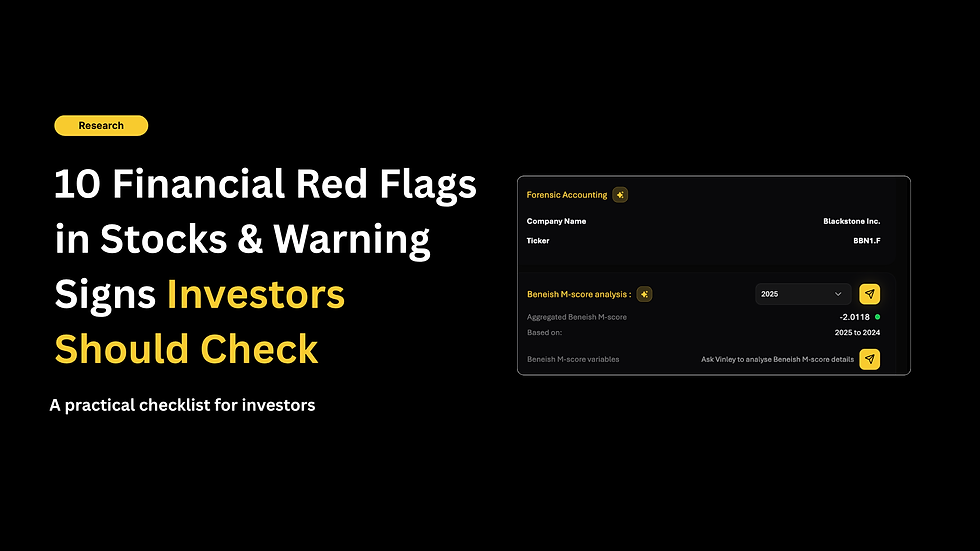
• Earnings manipulation (KO): the Beneish M-Score should sit in the safe zone (below roughly -2.22).
• Solvency: Altman Z-Score above 2.99, debt to equity below 2 (ideally below 1.5), and interest coverage above 8.
• Profitability: solid ROIC, supported by ROA and asset turnover.
• Passive income: dividends and/or share buybacks present, with a reasonable dividend payout ratio (between 30% and 70% of earnings), so the payout is sustainable rather than stretched.
A company that fails the KO criterion is set aside before a single hour goes into its valuation.

Step 2: Am I paying a fair price? (Intrinsic Value and Margin of Safety)
Relative measures like P/E, P/FCF, P/B, EV/EBIT and Tobin's Q give a first read. The decision, though, rests on absolute valuation: a Discounted Cash Flow model and a Discounted Future Earnings model.
• Require a 25 to 30% margin of safety between price and intrinsic value, under both models.
• Build the discount rate from the 30-year US Treasury yield plus Damodaran's industry cost of capital, so it reflects the business rather than your mood.
• Drop the terminal value and cap the forecast at 30 years. Few S&P 500 companies now survive beyond 15 to 20 years, so assuming cash flows forever is not conservative.
Because intrinsic value depends so heavily on its inputs, Vinley runs a sensitivity analysis for you. It suggests three starting assumptions:
• Cost of capital: an adequate rate based on the company's industry proxy.
• Risk spread: set according to the company's interest coverage ratio, so weaker debt servicing means a higher discount rate.
• Growth assumption: a starting rate that you can easily refine to match your own view of the business.
You can then see how the intrinsic value and margin of safety move as you change each one.

Step 3: Is the advantage real and durable? (Quantitative Moat)
Buffett and Munger taught us to look for moats. This step makes them measurable.
• ROIC of 6 to 8% or more, sustained for about 5 consecutive years.
• Brand value growing over time, tracked through rankings such as Interbrand or Kantar BrandZ.
• Customer sentiment positive (NPS, CSAT).
• Employee sentiment positive (eNPS, CEO approval), because culture shows up in results eventually.
Step 4: Is management a good steward? (Capital Allocation)
Follow the operating cash flow to its three destinations: reinvestment in the business, debt reduction, and shareholder remuneration.
• A sustainable dividend payout ratio between 30% and 70%.
• Absolute dealbreaker: a company raising debt to fund its dividends. No exceptions, however good the rest looks.

Step 5: What might I have missed? (Forensic Accounting)
A 10-year deep dive combining four independent tools:
• All 8 Beneish M-Score variables (DSRI, GMI, AQI, SGI, DEPI, SGAI, LVGI, TATA) in the safe zone.
• A consistent Altman Z-Score across the decade.
• Benford's Law, the statistical test auditors use to spot fabricated figures.
• The Sloan Ratio, a measure of accrual-based earnings quality.
Enron is the reminder of why these models belong together.

Step 6: Have I actually read the statements? (Reading the Financial Statements)
Ratios can all pass and you can still miss something. So read the filings in full, in this order: balance sheet first (it is the running scoreboard of every period since day one), then cash flow statement, and income statement last.
• Check the accounting policies for changes to revenue recognition or depreciation periods.
• Look for an unqualified audit opinion, no unaddressed critical audit matters, audit fees not dwarfed by consulting fees, and reasonable auditor tenure.
And when to sell
Selling is not the default. A business that keeps passing the screens and paying you to wait can be held for a very long time. Two triggers start a review:
1. The price runs ahead: the share price rises at least 15% above your own intrinsic value estimate. Your margin of safety has turned into a margin of risk.
2. The business falls behind: your intrinsic value estimate drops below the share price. Then diagnose: a temporary glitch is a reason for patience, a structural break is a reason to sell, even at a loss.
This is why you keep a written record of your valuation at the time of purchase and learn over time from your investing mistakes.
DISCLAIMER : Investing into stock markets carries a certain degree of risk. This article is for educational purposes and not meant to be considered investment advice. Do your own research.


Comments